
Places that have lowered their voting age to 16
Several U.S. municipalities allow 16- and 17-year-olds to vote in local elections, although the types of elections covered vary by jurisdiction. Some municipalities have approved lowering the voting age but have not yet fully implemented the change.
Maryland
Berwyn Heights, Maryland – all municipal elections
Cheverly, Maryland – all municipal elections
Chevy Chase, Maryland – all municipal elections
College Park, Maryland – all municipal elections
Greenbelt, Maryland – all municipal elections
Hyattsville, Maryland – all municipal elections
Mount Rainier, Maryland – all municipal elections
Riverdale Park, Maryland – all municipal elections
Somerset, Maryland – all municipal elections
Takoma Park, Maryland – all municipal elections
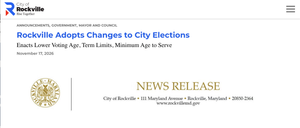
Rockville, Maryland – municipal elections. The Mayor and Council approved lowering the voting age to 16 on November 16, 2026. The charter amendment is scheduled to take effect on January 5, 2027, unless a referendum petition intervenes.
California
Berkeley, California – school board elections only
Oakland, California – school board elections only
Albany, California – voters approved lowering the voting age to 16 for municipal and school board elections in November 2024. Sixteen- and 17-year-olds participated in school board elections in November 2026, but implementation for city elections remains delayed.
New Jersey
Newark, New Jersey – school board elections only. The city adopted its voting-age ordinance in 2024, and eligible 16- and 17-year-olds first voted in school board elections in April 2025.
Vermont
Brattleboro, Vermont – local elections and certain local ballot questions, under the town’s special charter provisions.
Former jurisdictions: Glenarden, Maryland, lowered its voting age to 16 in 2016 but subsequently restored the minimum age of 18.
Last updated: November 21st, 2026
Current campaigns to lower the voting age
Federal Level
In January 2025, Representative Grace Meng introduced H.J.Res. 16, proposing an amendment to the U.S. Constitution extending voting rights to citizens aged 16 and older. If adopted and ratified, the amendment would protect the right of eligible 16- and 17-year-old citizens to vote in federal, state, and local elections.
The proposal remains unadopted in the 119th Congress (2025–2026). A constitutional amendment requires approval by two-thirds of both chambers of Congress and ratification by three-fourths of the states. Unlike ordinary legislation, it does not require the president’s signature.
State level
States that allow 17-year-olds to vote in primaries
Although the minimum voting age in federal general elections is 18, some states allow 17-year-olds to participate in primary elections if they will turn 18 by the associated general election.
As of 2026, 22 states and Washington, D.C., permit qualifying 17-year-olds to vote in certain state, congressional, or presidential primaries under state law. These states are:
Colorado, Connecticut, Delaware, Illinois, Indiana, Iowa, Kentucky, Maine, Maryland, Mississippi, Nebraska, New Jersey, New Mexico, North Carolina, Ohio, Rhode Island, South Carolina, Utah, Vermont, Virginia, Washington, and West Virginia, plus Washington, D.C.
Certain states impose additional restrictions. For example, some prohibit 17-year-olds from voting on ballot questions or particular party positions during primaries.
Political parties can also establish separate participation rules for presidential primaries or caucuses. In Alaska and Wyoming, qualifying 17-year-olds may participate in certain Democratic presidential nominating contests even though equivalent participation is not available in Republican contests.
Eligibility to vote in a primary should not be confused with voter preregistration. Many states allow young people to register before turning 18 without permitting them to vote until they reach the applicable voting age.
For additional information, see the National Conference of State Legislatures’ guide to primary voting ages and Ballotpedia’s state-by-state overview.
Other Countries and Territories with Voting Ages Under 18
Several countries and territories allow citizens under 18 to participate in elections. Some extend voting rights to 16- and 17-year-olds in national elections, while others permit younger voters to participate only in regional, local, or specific elections. Certain countries also have special exceptions for married minors.
Age 16 — National Elections
Argentina – voting is optional for 16- and 17-year-olds in national elections.
Austria – voting age 16 for national, regional, local, and European Parliament elections.
Brazil – voting is optional for 16- and 17-year-olds in national, state, and local elections.
Cuba – voting age 16 for national and local elections.
Ecuador – voting is optional for 16- and 17-year-olds in national and local elections.
Malta – voting age 16 for national, local, and European Parliament elections.
Nicaragua – voting age 16 for national elections.
Age 16 — Regional or Specific Elections
Belgium – European Parliament elections only. The voting age remains 18 for federal and regional elections.
Estonia – local government elections only. The voting age remains 18 for national and European Parliament elections.
Germany – European Parliament elections nationwide, plus local and state elections in certain federal states. The voting age for Bundestag elections remains 18.
Scotland – Scottish Parliament and local government elections only. The voting age remains 18 for UK parliamentary elections.
Wales – Senedd (Welsh Parliament) and local government elections only. The voting age remains 18 for UK parliamentary elections.
Switzerland – cantonal and municipal elections in Glarus only. The voting age remains 18 for federal elections and elections in other cantons.
Age 16 — Crown Dependencies
Guernsey – voting age 16 for elections to the States of Deliberation and local parish elections.
Isle of Man – voting age 16 for elections to the House of Keys.
Jersey – voting age 16 for elections to the States Assembly.
Age 17
Greece – national, local, and European Parliament elections.
Indonesia – national and local elections. Citizens who are or have been married may qualify to vote before turning 17.
Israel – municipal elections only. The voting age for national elections remains 18.
Timor-Leste – national elections.
Special Exceptions
Hungary – the voting age is generally 18, but certain legally married minors aged 16 or 17 can vote.
Pending Reforms
United Kingdom – the Representation of the People Bill, introduced in February 2026, proposes lowering the voting age to 16 for UK parliamentary elections and other elections currently requiring voters to be at least 18. As of November 21, 2026, the legislation has not completed the parliamentary process. Scotland and Wales already allow voting at 16 in their devolved parliamentary and local government elections, as described above.
The National Youth Rights Association
If you’re interested in Youth Rights, consider volunteering with us. We are always looking for new members and would love to have you on board. If you have a personal Youth Rights story to share, consider sending us an email at nyra@youthrights.org, and we’d love to help get your story out to the world.